
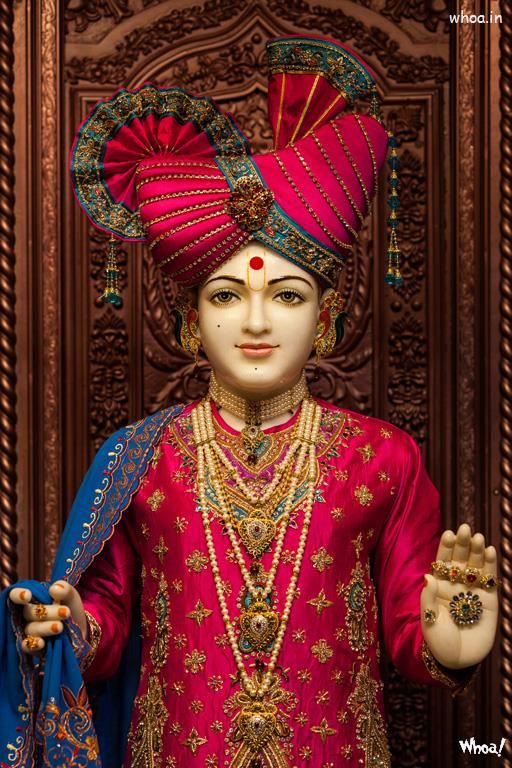
Date of Birth
3rd April 1781
Swaminarayan ( 3 April 1781 – 1 June 1830), also known as Sahajanand Swami, was a yogi and ascetic whose life and teachings brought a revival of central Hindu practices of dharma ahimsa and brahmacharya. Followers believe him to be a manifestation of God.
Swaminarayan was born Ghanshyam Pande in Chhapaiya, Uttar Pradesh, India, in 1781. In 1792, he began a 7-year pilgrimage across India at 11 years, adopting Nilkanth Varni. During this journey, he did welfare activities, and after nine years and 11 months of this journey, he settled in the modern-day Indian state of Gujarat around 1799. In 1800, he was initiated into the Uddhav sampradaya by his guru, Swami Ramanand, and was given Sahajanand Swami. In 1802, his guru handed over the leadership of the Uddhav Sampraday to him before his death. Sahajanand Swami held a gathering and taught the Swaminarayan Mantra. From this point onwards, he was known as Swaminarayan. The Uddhav Sampraday became known as the Swaminarayan Sampradaya.
Swaminarayan developed a good relationship with the British Raj. He had followers not only from Hindu denominations but also from Islam and Zoroastrianism. He built six temples in his lifetime and appointed 500 Paramahamsa to spread his philosophy. In 1826, Swaminarayan wrote the Shikshapatri, a book of social principles. He died on 1 June 1830 and was cremated according to Hindu rites in Gadhada, Gujarat. Before his death, Swaminarayan appointed his adopted nephews as acharyas to head the two dioceses of Swaminarayan Sampradaya. Swaminarayan is also remembered within the sect for undertaking reforms for women and the poor and performing non-violent yajnas (fire sacrifices) on a large scale.
Source: Wikipedia
3rd April 1781
Chhapaiya, Uttar Pradesh
Shri Swaminarayan Mission
Swaminarayan ( 3 April 1781 – 1 June 1830), also known as Sahajanand Swami, was a yogi and ascetic whose life and teachings brought a revival of central Hindu practices of dharma ahimsa and brahmacharya. Followers believe him to be a manifestation of God.
Swaminarayan was born Ghanshyam Pande in Chhapaiya, Uttar Pradesh, India, in 1781. In 1792, he began a 7-year pilgrimage across India at 11 years, adopting Nilkanth Varni. During this journey, he did welfare activities, and after nine years and 11 months of this journey, he settled in the modern-day Indian state of Gujarat around 1799. In 1800, he was initiated into the Uddhav sampradaya by his guru, Swami Ramanand, and was given Sahajanand Swami. In 1802, his guru handed over the leadership of the Uddhav Sampraday to him before his death. Sahajanand Swami held a gathering and taught the Swaminarayan Mantra. From this point onwards, he was known as Swaminarayan. The Uddhav Sampraday became known as the Swaminarayan Sampradaya.
Swaminarayan developed a good relationship with the British Raj. He had followers not only from Hindu denominations but also from Islam and Zoroastrianism. He built six temples in his lifetime and appointed 500 Paramahamsa to spread his philosophy. In 1826, Swaminarayan wrote the Shikshapatri, a book of social principles. He died on 1 June 1830 and was cremated according to Hindu rites in Gadhada, Gujarat. Before his death, Swaminarayan appointed his adopted nephews as acharyas to head the two dioceses of Swaminarayan Sampradaya. Swaminarayan is also remembered within the sect for undertaking reforms for women and the poor and performing non-violent yajnas (fire sacrifices) on a large scale.
Source: Wikipedia
Swaminarayan Sampraday
Shikshapatri, Vachanamrut, Satsangi Jeevan
91 9377730616
DELHI
India


Add a comment